The record
What the documentary didn’t show
Flanders’ public broadcaster accused a local church and its Ghanaian bishop of running a sect. It did not tell its viewers who its witnesses were, or what the bishop has taught for decades. This site and the films that go with it aim to tell a more complete story.
Watch the films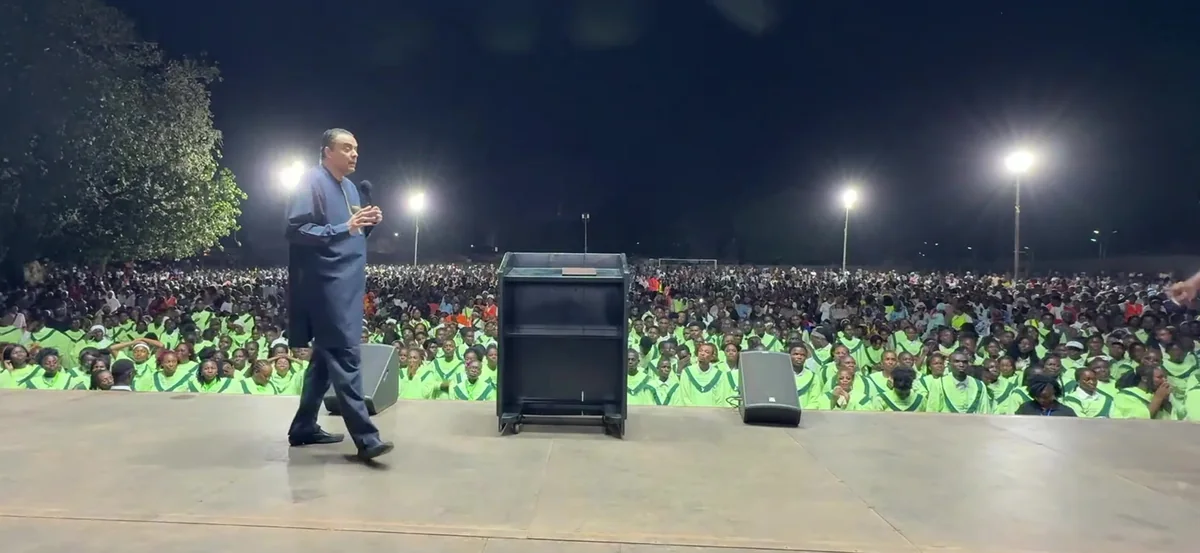
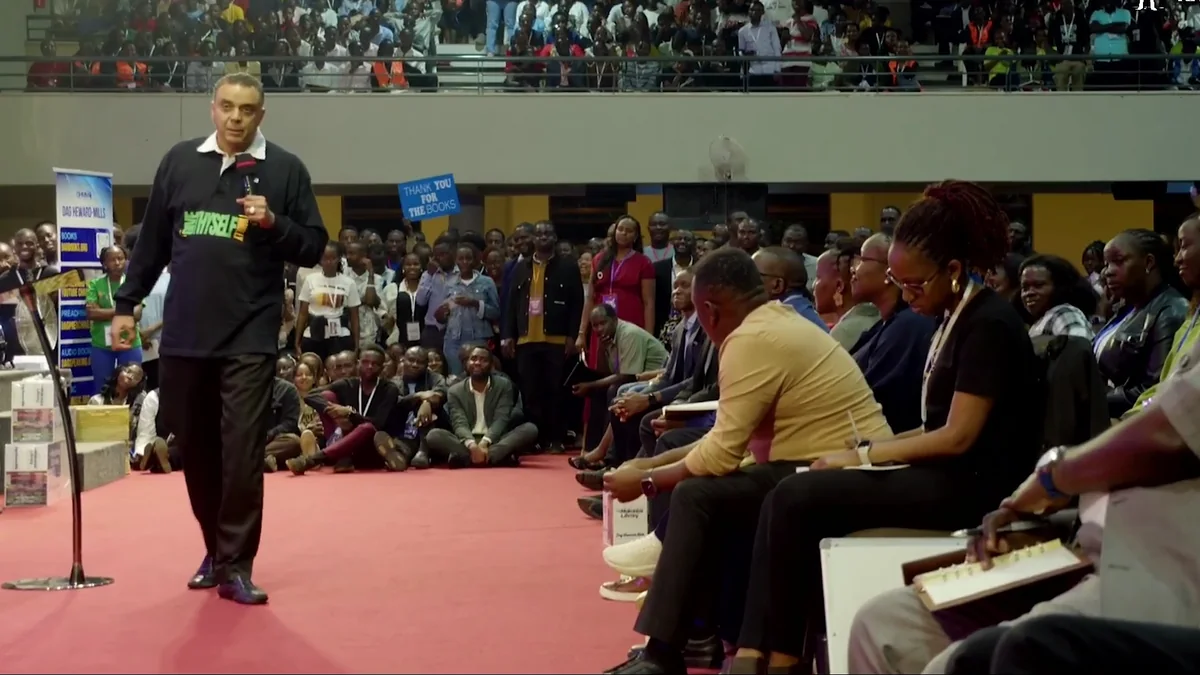
Bishop Dag Heward-Mills at a night crusade in Banjul, The Gambia, 2026. Frame from the ministry’s public broadcast.
An independent project. Not an official ministry channel.
Chapter I
The witnesses
Who VRT asked viewers to believe, and what it left unsaid.
On the evening of Wednesday, October 21st, a Belgian television programme called Pano aired a forty-six-minute documentary about a church most of its viewers had never heard of. Pano is made by VRT, the public broadcaster for Flanders, the Dutch-speaking part of Belgium. The film was called “Undercover bij Go Church” (“Undercover at Go Church”), and it was made with the newspaper De Morgen.
It opened with secret camera footage from a church hall in Merksem, near Antwerp. It ended with a verdict. A young church in Antwerp, Ghent and Leuven, the film said, was manipulating teenagers, taking their money and serving a bishop from Ghana as if he were a god.
Within two days, doors began to close. The city of Mechelen ended a hall contract. The university in Leuven, KU Leuven, stopped the church from using its rooms. Turnhout shut a youth centre to it. Venues in Antwerp and Sint-Niklaas cancelled bookings. No court had ruled against the church. No one had been charged with a crime. The film alone was enough.
It was enough because people trust Pano. Viewers believe what it shows them, because it uses real people, named experts, hidden cameras and a reporter on the ground in Ghana. So the first thing to check is who these people were. The programme told its audience what these people said. It did not tell them who they were. This chapter does.
The investigation did not start with a tip from inside the church. By the programme’s own account, it started with a post on TikTok. An anonymous young religion teacher asked teenagers in Antwerp to send Pano anything they had experienced “that should be investigated”. More than thirty former members answered.
These former members were describing their own lives, and their accounts deserve to be heard. But when you ask for complaints, you get complaints. Go Church says that about four hundred and fifty people attend each week. The film did not give that number. And it did not put a single current member’s experience on camera.
Then the reporters flew to Ghana.
There, the narrator says, they met “six former bishops”. These were men who had worked for years alongside Bishop Dag Heward-Mills. He is the founder of Lighthouse Chapel International, a family of churches that started in Ghana, and Go Church belongs to that family. The six men had spoken about the church to a Ghanaian journalist five years earlier.
“Six former bishops” sounds powerful. It is also wrong. Only two of the six were bishops. The other four were a reverend and three pastors.
Those two bishops give the film its strongest accusations. Lawrence Odonkor says that if the devil walks the earth, he appears as Dag Heward-Mills. Emmanuel Oko Mensah says the church’s money is “channelled to Mills”, meaning it flows to Bishop Dag.
Here is what the film does not tell you. Both men have been suing the church since April 2021. They are the lead plaintiffs (the people who bring the case) in a dispute over pay and pension payments. They are on the other side of a court case against the church that is still going on.
And the film does not tell you what happened to Odonkor in Madagascar.
Odonkor used to run the church’s branch in Madagascar, an island country off the east coast of Africa. The church trusted him with its people and its property. That property included the branch’s official car, a 2003 Toyota Land Cruiser.
In 2022, his former assistant in Madagascar, the Rev. Edmund Amartey, published the WhatsApp messages Odonkor had sent him about that car. “Sell it to the highest bidder pls,” one message says. According to the messages, part of the money from the sale paid for land Odonkor was buying. Another message, sent to the church’s office in Ghana, reads: “This is Bishop Larry! The amount is 19,500,000 Ar.” (Ar is short for ariary, Madagascar’s currency.) The last screenshot shows a receipt for $5,237 paid into his own bank account in Accra, Ghana’s capital, and his reply: “Thank you!”
When the messages came out, Odonkor apologised to Amartey in public, “for how you feel”. The Ghanaian news site MyJoyOnline, part of Joy News, reported that his apology admitted his former assistant’s story was true.
Then the case went to court in Madagascar. According to the Ghana News Agency, the prosecution gave the court WhatsApp messages showing that he “had directed the sale and requested the proceeds”.
On April 18th, 2023, a criminal court in Antananarivo, Madagascar’s capital, found him guilty. The charges were fraudulent breach of trust and embezzlement of the church’s property. In plain words, he was trusted to look after something that belonged to the church, and he used it for himself. The court sentenced him to two years in prison. It ordered him to pay 75 million ariary in damages to the church.
He appealed, which means he asked a higher court to overturn the decision. In May 2024 he lost. He appealed again. In November 2025, three judges dismissed that appeal “as lacking merit”, the Ghana News Agency reported, and upheld the first judgement in full. The agency also reports that there is now a warrant for his arrest. If he enters Madagascar, he is to be detained.
In other words: the man Pano used to tell viewers that this church is about money was himself convicted of taking the church’s property. He has appealed twice, and lost both times.
The second bishop, Emmanuel Oko Mensah, had a different complaint. He said the church had not paid his pension contributions, the money set aside for his retirement.
Ghana’s state pension fund, SSNIT, looked into it. In August 2021 it said the church had paid. Oko Mensah worked as a full-time pastor from August 2003 to November 2018, its statement said, “during which period his contributions were paid”.
So the official body that runs Ghana’s pensions found that the church had paid what he said it had not.
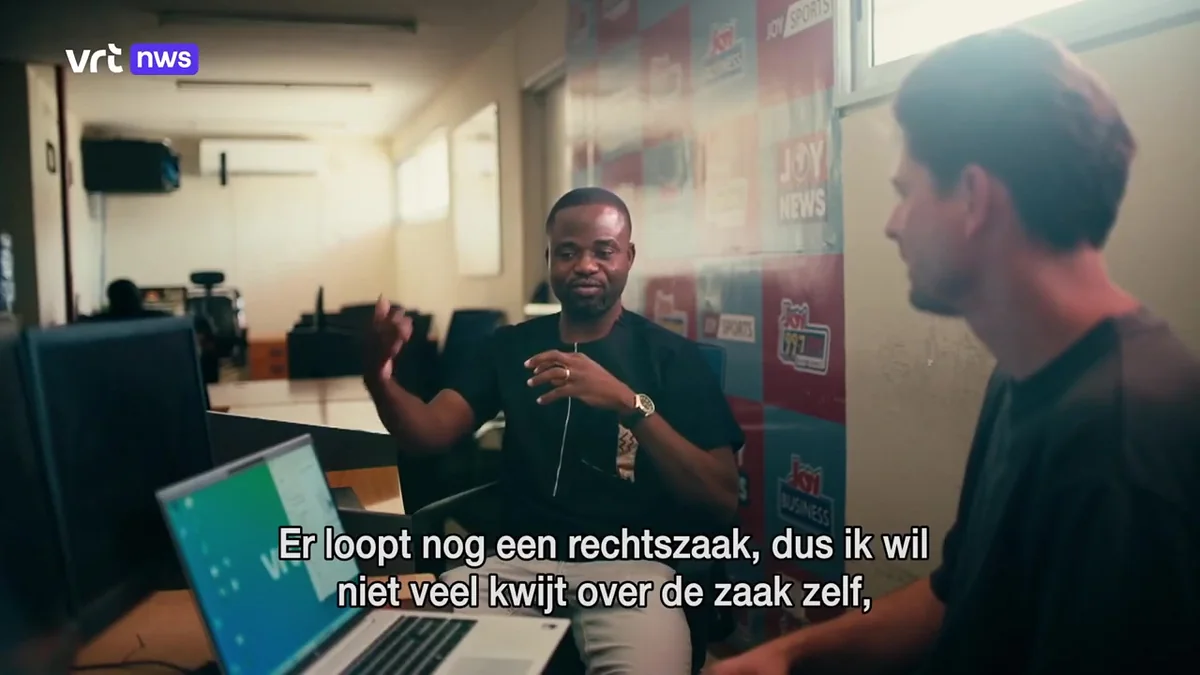
The journalist who brought these men together is Manasseh Azure Awuni. Pano introduces him as an investigative reporter. On camera he says: “There’s still a court case, so I don’t want to say much.” The film leaves it there. It does not say whose court case it is.
It is the church’s case against him. In December 2021, Lighthouse Chapel International sued Awuni1 Graphic Online; Ghana News Agency, Jul 2026 and his publishers for defamation, which means harming someone’s reputation by publishing false things about them. The stories it sued over are the same stories VRT went to Ghana to repeat. That trial is still going on.
In October 2022, the Ghana News Agency reported, the High Court in Accra found Awuni guilty of contempt of court in that case. Contempt of court means disobeying or disrespecting a court while a case is going on. Here, it was for publishing about matters the court had not yet decided. The court fined him. It also ordered him to apologise publicly to the church and to Bishop Dag.
One of Awuni’s most shocking claims, repeated on VRT, is that a pastor tried to kill himself “several times”. In court in January 2025, Awuni was cross-examined, meaning he was questioned by the church’s lawyer. According to reports of the hearing by Citi Newsroom and GhanaWeb, he agreed that he had not obtained the pastor’s medical records before publishing the claim.
And there is one more link. Odonkor, the convicted former bishop, is listed as a witness for Awuni’s defence in that same trial.
So here is the full picture. The journalist is being sued by the church. The two bishops are suing the church. One of those bishops was convicted of taking the church’s property, and he is also the journalist’s witness. Every Ghanaian voice the film used against the church is in a court case with it. VRT told its viewers none of this.
Pano’s experts carried a different kind of authority. Viewers expect an expert to be neutral.
The first is Johan Detraux. On screen he is called a “religious psychologist and former Jehovah’s Witness”. He talks about a “honeymoon phase”, a “rabbit hole” and “a tangle of emotional manipulation”. VRT told viewers which religion he had left. It did not tell them what he has done since. He chaired a Flemish study and advice group on sects (the S.A.S., Studie- en Adviesgroep Sekten). He sat, as a substitute member, on the Belgian government’s centre that watches sects. And he wrote a book that presents sects as a hidden danger inside Belgian society.
In other words: he is not a neutral observer. He has worked against sects for about twenty years. Nothing VRT published suggests he ever studied Go Church. Yet the programme told viewers that the abuse it describes “does not surprise” him.2 VRT NWS, abuse article, 21 Oct 2026
The second expert is a sociologist, Wim Vandewiele. He was more careful than the film around him. On screen he says there are “traces” of a harmful movement, and he adds that such groups “are certainly not banned”.
And the facts behind the film’s word “sect” are simple. No court has ruled against Go Church. No one has been charged with anything.
Last, there is the church’s answer.
Pano contacted the church, and the church replied in writing, in detail, two days before the broadcast. It covered the money, young people, therapy, hobbies, friends, and the case of the former leader.
Near the end of the film, the narrator told viewers that neither Bishop Dag nor the church’s pastor had responded. About a minute and a half later, the film used one sentence from the church’s long reply: the pastor “denies all allegations”, and as for the abuse, “we dealt with it.”
Forty-six minutes of accusation. Eleven seconds of answer. Is that fair? The rest of the reply was put on a webpage most viewers would never read.
vrtnws.be21 oktober 2026
De reactie van Go Church
Waar gaat het geld naartoe dat tijdens diensten en evenementen wordt ingezameld?
Het geld wordt gebruikt om de huur en andere operationele kosten te betalen voor de locaties waar onze kerken samenkomen.
Welk percentage van de donaties van jongeren of van hun uitgaven aan boeken, gaat naar Lighthouse in Ghana?
Go Church België maakt geen percentage van de tijdens diensten en evenementen ingezamelde donaties over aan Lighthouse in Ghana.
Waarom wordt het leden moeilijk gemaakt om uit de kerk te stappen?
Leden zijn vrij om Go Church op elk moment te verlaten. We verplichten niemand om te blijven en verwachten ook niet dat leden hun vriendschappen met degenen die vertrekken, beëindigen. We erkennen dat het verlies van vriendschappen pijnlijk kan zijn, hoewel we ons niet kunnen uitspreken over de persoonlijke relaties van elk individu.
Welke maatregelen heeft Go Church genomen toen de beschuldigingen tegen Kojo* aan het licht kwamen?
Hij was destijds werkzaam als vrijwilliger en was niet de verantwoordelijke pastor van de kerk. Toen de kerk kennis nam van de beschuldigingen, werd hij onmiddellijk en definitief uit de kerk verwijderd. Geen van de betrokken vrouwen was ten tijde van de incidenten minderjarig.
Zijn de beschuldigingen gemeld bij de politie of een andere beschermingsinstantie?
De kerk heeft de beschuldigingen niet bij de politie gemeld. Alle betrokken vrouwen waren op het moment van de incidenten meerderjarig. Ze werden aangemoedigd om de beschuldigingen bij de politie te melden en kregen de verzekering dat de kerk hen daarbij volledig zou steunen. Ze weigerden dit en vroegen de kerk uitdrukkelijk om de zaak niet namens hen te melden. De kerk respecteerde hun wensen. Hun besluit weerhield de kerk er niet van om maatregelen te nemen: Kojo werd onmiddellijk en definitief uit de kerk gezet.
The Gospels describe a case that was also built from witnesses. At Jesus’ trial, Mark writes, “the chief priests and all the council sought for witness against Jesus to put him to death; and found none. For many bare false witness against him, but their witness agreed not together” (Mark 14:55-56). The council had already decided what it wanted, and then went looking for people to say it. This chapter does not call anyone a liar. It asks what any fair judge asks first: who the witnesses are, and what they stand to gain.
The people who spoke to Pano had things to say. But viewers were asked to trust them without being told who they were.
Put together, the case looks like this. It started with an anonymous call for complaints. It used “six former bishops”, when four were not bishops. Two of its main voices are suing the church, and one of them was convicted of taking its property. The journalist who found them is on trial for defamation over the same stories. And its main expert has worked against sects for about twenty years.
That is the case. What follows is the record.
Translations from Dutch in this series are ours unless stated otherwise.
Notes
The questions, answered
- Is Go Church a sect, as the VRT documentary Undercover bij Go Church suggests?No Belgian authority has classified Go Church as a sect. No court has ruled against Go Church.
- Does the money given at Go Church go to Bishop Dag Heward-Mills?No evidence shows that it does. Go Church told VRT that its collections pay the rent and running costs of the halls where it meets and that no percentage goes to Lighthouse in Ghana, and the former bishop who said the money is channelled to him added, on camera, “What he does with it, I don’t know.”
- Does Go Church target children and minors, as the VRT documentary claims?Go Church told VRT in writing that it does not specifically target minors, that a pastoral visit to a member under 18 needs the parents’ consent, and that every church activity is voluntary.
- Do Go Church members treat Bishop Dag Heward-Mills like a god?No: since at least 2001, in Europe, Africa and America, Bishop Dag Heward-Mills has told his listeners that he is just a man and that they should follow Christ, not him.
- How did Go Church handle the abuse case in VRT’s documentary, and what does Bishop Dag Heward-Mills teach about abuse?Go Church says the man was questioned, admitted the accusations against him and was removed immediately and permanently.
- Did Go Church respond to the VRT documentary’s questions before it aired?Yes, Go Church answered VRT’s questions in writing on Monday 19 October 2026, two days before the broadcast, and VRT put one sentence of that answer on air.
Chapter II
The man
A doctor, a church begun in a medical school classroom, and what he built after it.
On the evening of Thursday, October 15th, six days before Pano went on air, Bishop Dag Heward-Mills was preaching in the Accra Sports Stadium in Ghana. It was the evening rally of the World Assemblies of God Congress. The Assemblies of God is one of the largest Pentecostal fellowships in the world (Pentecostal churches are a branch of Christianity that puts special weight on the Holy Spirit), and Bishop Dag is a member of it. Behind him stood a wall of orange light.
He spoke for fifty minutes about a single Bible verse, John 3:17, and said very little about himself. He asked the stadium to think about the places that have never heard the name of Jesus. “Is it not the case that huge areas of this world seem not to know Jesus at all, at all?” he said. “God did not send Jesus Christ into this world to condemn countries, nations, cities, continents, but rather that the world through Him might be saved.”
Six days later, viewers in Belgium met the same man, described very differently. The narrator told them he leads a “one-man church”. The film’s fullest picture of him came from Lawrence Odonkor, the former bishop who, as Chapter I showed, was convicted in Madagascar of taking the church’s property. If the devil walks the earth, Odonkor said, he appears as Dag Heward-Mills: “He uses his genius to do evil.”1 VRT broadcast, 23:30 VRT put that sentence over film of Bishop Dag’s open-air meetings, over a man throwing away his crutches and sick people being carried forward on stretchers.
The film never mentions, in its narration or its subtitles, that he trained as a doctor.
So this chapter looks at the man the film described. He is not hard to find. Most of it is on the public record, and much of it is in his own words.
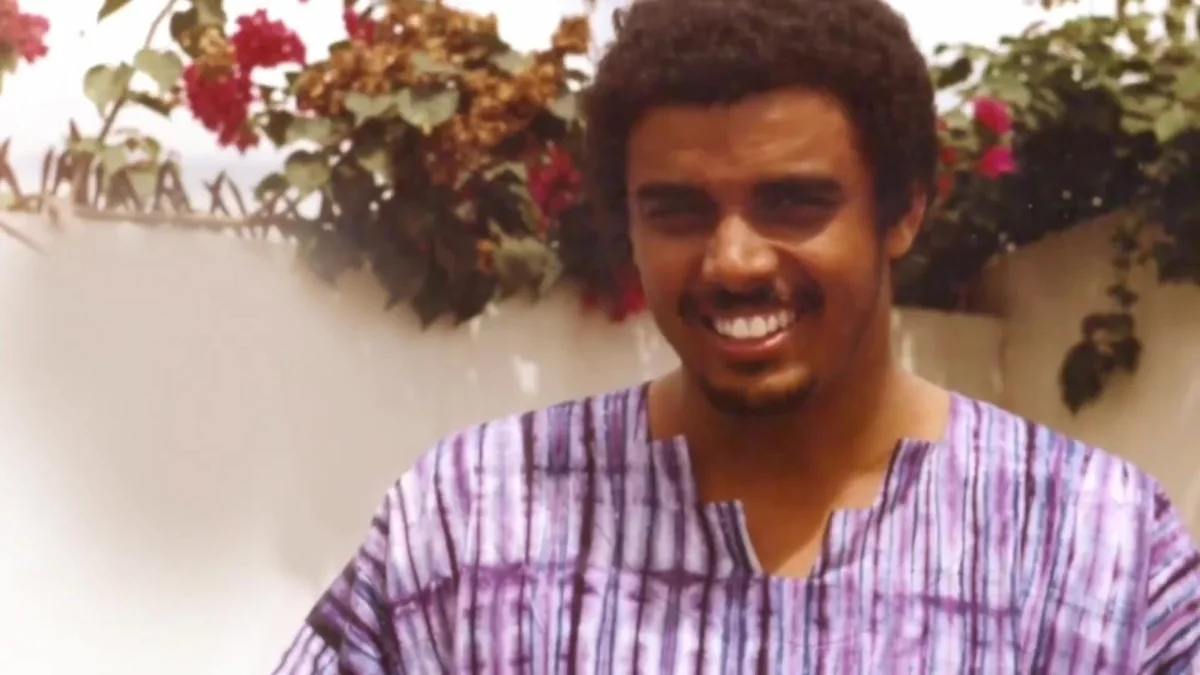
He was born in London in 1963, to a Ghanaian father and a Swiss mother, according to the University of Ghana’s former-students office. His mother, he has said, came from the Swiss city of Basel. He was taken to Ghana as a baby. “I grew up in Ghana all my life, actually,” he told an interviewer in Seattle, in the United States, in 2008.2 Recording, from 11:13 He studied medicine at the University of Ghana Medical School from 1982 to 1989.3 Recording, from 39:01
Halfway through his studies, he started a church. It met in a classroom at Korle Bu, Ghana’s main teaching hospital in Accra, and later in a canteen. “Everybody in the church was a student,” he said in Paris in 2009, “and everybody was poor, just like me.”4 Recording, from 23:02 He qualified and worked as a doctor.5 Recording, from 2:12:34 Then he stopped, to preach full-time.
What he gave up is easy to measure. At the stadium this month he put a number on it: “almost my entire class, 55 of us, are living in America. They’re all physicians and doctors.” In Paris he said it more simply. “I gave up medicine to become a preacher. It looked foolish at the time.” Then he read Matthew 6:33: “But seek ye first the kingdom of God, and his righteousness; and all these things shall be added unto you.”
He never fully left medicine. He still helps medical students prepare for their exams. That habit answers one of the film’s charges directly, and Chapter III tells that story.
The classroom church kept growing. By 2008, he told the Seattle interviewer, it had “become, you know, a worldwide church.”6 Recording, from 1:50:02 He lists its cities himself: Geneva, Zurich, London, Manchester, New York, Toronto, Sydney, Johannesburg, Nairobi. In Britain it has been a registered charity since 2005.
In other words: the “one-man church” began as a student church run by a medical student, and it grew into a church in many countries.
The church was not all he built.
His first hospital, St. Kathryn’s, is in Accra. Church Growth International, a worldwide network of church leaders, describes it on its website as a forty-bed hospital. It offers general medicine and surgery, care for women and childbirth, and eye care. The ministry adds that it has a clinic for pregnant women, a dental clinic and an operating theatre. He drew the plans himself. “When our hospital was being built I designed it myself,” he told a congregation in Mampong, Ghana, in 2015, “because I’ve worked in the theatres.” The ministry’s website also names a second hospital, St. Gamaliel’s. Its name is written across the front of the building in the ministry’s own photograph.
By his own account, a third hospital was built for people who have lost arms or legs. In 2023 he described how it began: “I slept and I woke up weeping about some people whose legs were cut off… the Lord has spoken to me that I should do something for this kind of people… that’s why we built that whole hospital.”7 Recording, from 3:06:21; Recording, from 2:13:10 A year earlier he had told a congregation what it does. It is there “to make legs and arms,” he said, “and it’s free.”
He has been honest that this side of his work came late. In 2005, speaking to pastors in Accra, he described a change of mind. “Recently the Lord started to deal with me about certain things: to care for the poor, to care for the sick, to care for orphans, to care for prisoners.” Before that, he said, “I thought all these things are sidetracking from the main work of God, which is to evangelize and to win souls and to plant churches.” Then: “When I realized that, I started to build my orphanage quickly. My orphanage is complete now. And the hospital is also almost complete.”
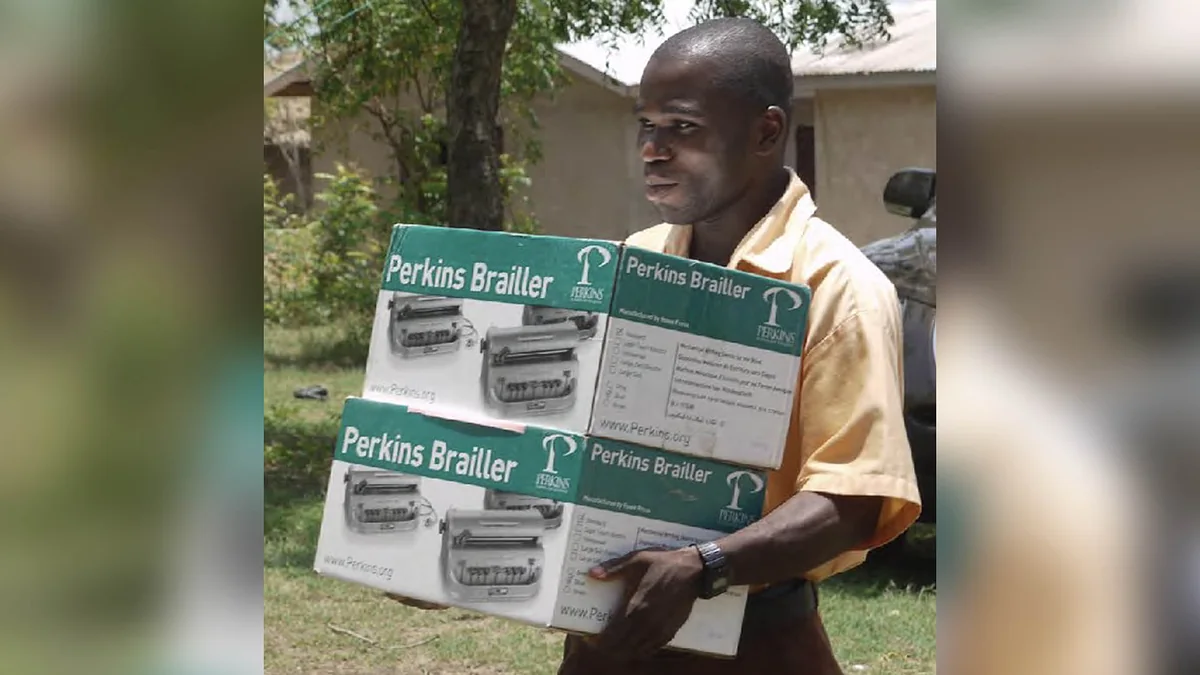
The orphanage is the Lighthouse Christian Home.8 Recording, from 11:23 The ministry says it was inspired by Jesus’ words in Matthew 25. The University of Ghana’s former-students office says his wife, Adelaide, runs it. Through the ministry’s charity Help the Helpless, Braille learning materials have been published for blind pupils in junior high schools. (Braille is the raised-dot writing that blind people read with their fingers.) The ministry’s photographs show Perkins Braillers, the machines used to type Braille, being delivered. Its churches have also repaired schools for deaf children in Ghana and given supplies to schools for the deaf in Côte d’Ivoire.9 daghewardmills.org
The ministry also feeds prisoners. It says it sends food to prisoners in Accra every month, and its photographs show a prison corridor before and after repairs. On Christmas Eve 2019, the news site Citi Newsroom reported, church members in the town of Sunyani fed 850 prisoners at the central prison, with money the church had raised. Two years later, the Ghana News Agency reported that a branch in Koforidua fed prisoners at the central police station and served a Christmas meal to children at the regional hospital.
Then there are his open-air meetings, the footage VRT chose for the word “evil”. Since 2004 he has held the Healing Jesus Campaign. These are meetings in the open air that last several days, mostly in African towns. The ministry counts 275 of them in forty-one countries. In 2008 the Seattle interviewer asked whether his medical training had shaped them. “We have a clinic, a huge clinic,” he said. “We go with a large team of medical people… and then we give drugs, free. Everything’s free.” The worst cases are brought to Accra. “When there are certain really bad cases which we can help surgically, we bring them to Accra, because we have a hospital that we built, to operate on them and look after them free of charge, and send them back.”
Newspapers have reported this from the ground. The Gambian newspaper The Point reported free medical care at one of his campaigns in 2012. In Tumu, in northern Ghana, in May 2024, the Ghana News Agency reported free health checks and medicine. It also reported two thousand sleeping mats, a thousand buckets and five hundred cutlasses (farming knives) given out.
In other words: VRT showed sick people arriving at his meetings and called it “evil”. It did not show what was waiting for them there: free doctors, free medicine and free surgery.
Jesus faced the same accusation. When He healed a man who was blind and could not speak, His critics could not deny the healing. So they said the devil was behind it: “This fellow doth not cast out devils, but by Beelzebub the prince of the devils” (Matthew 12:24). Beelzebub was a name for the devil. After His death, the same religious leaders called Him “that deceiver” (Matthew 27:63). The film did the same thing to Bishop Dag. It put a former bishop’s word for the devil over pictures of sick people being helped.
The film also did not mention the respect he has among other church leaders.
In September 2016, at the Pentecostal World Conference in São Paulo, Brazil, he was elected to the Executive Council of the Pentecostal World Fellowship, the radio station Citi FM reported. That is the leadership body of a worldwide network of Pentecostal churches. Church Growth International’s website lists him on its board. That network was founded in 1976 by David Yonggi Cho at Yoido Full Gospel Church in Seoul, South Korea. The same page lists him on the board of Empowered21, another worldwide Pentecostal network. Cho himself once came to Accra to open the church’s old building, which Bishop Dag still describes as being “in a slum”. In October 2024, Church Growth International’s conference at Yoido gave him its Friday night service, in the church’s main hall.
In Abuja, Nigeria, in August 2025, the pastor Paul Enenche, who is also a medical doctor, introduced him to the Dunamis church as “medical doctor trained, left the medical practice and stepped into the ministry, started on campus”. Enenche said the only other place he had seen “the restlessness of just aggressive going everywhere was with Bishop Dag”. At a Good Friday service in Accra in 2016, Ghana’s president at the time, John Mahama, said: “On behalf of the government and people of Ghana, I want to commend Bishop and the Lighthouse Chapel.”
And this month, the Ghana News Agency reported, the World Assemblies of God Fellowship listed him among the speakers at its congress in Accra, next to its own chairman and vice-chairman. That was the stadium where this chapter began.
Next, his books. The film gave them one line.
Pano said he had sold “eighty million books, by his own account”. That is the ministry’s own figure, and the books are published in fifty-three languages.10 VRT broadcast, 33:03 The film showed a stack of them. Then it cut to Odonkor holding one up. “Dag’s books are perhaps even more important than the Bible,” Odonkor said.11 VRT broadcast, 33:15
That is the claim. The man who made it is the former bishop convicted of taking the church’s property. And Bishop Dag has said the opposite, again and again, for more than twenty years. In Cardiff, Wales, in 2003, he told a congregation:
> I’m your pastor, but I’m not your real pastor. Your real shepherd is Jesus. So I must direct you to Jesus’ words and to his book, and to the Bible. I can’t direct you away from the Bible to my books, you understand, because my books also came from the Bible. The part of my books that are not from the Bible should not be there.
In August 2026, at a conference for pastors called Give Thyself Wholly, about eleven weeks before the broadcast, he said: “Read the books, like Ezra. Become a scholar. Because I’m not teaching something that is not in the Bible. Like, I’m not creating or inventing a doctrine.”12 Recording, from 3:46:53 He once described one of his books as “just my notes of Bible study”.
The Bible itself shows why a book that explains the Bible can help. In the eighth chapter of Acts, an official from Ethiopia, the treasurer of Queen Candace, is reading the prophet Isaiah in his chariot. Philip, one of the first Christians, runs up beside him and asks, “Understandest thou what thou readest?” The man answers, “How can I, except some man should guide me?” (Acts 8:30-31). Philip climbs in and, Luke writes, “began at the same scripture, and preached unto him Jesus” (Acts 8:35). In Soweto, South Africa, in 2016, Bishop Dag read this same story to a conference and drew the lesson: “There are many things you will not really understand until somebody guides you to understand.”13 Recording, from 6:31
His books follow a Christian’s life from the first day to the last. At the start are Key Facts for New Believers and How to Be Born Again and Avoid Hell. Then come Read Your Bible, Pray Every Day, How to Pray, The Art of Hearing, Forgiveness Made Easy, Model Marriage and Daughter, You Can Make It. On serving God there are It Is a Great Thing to Serve the Lord and Laikos: Lay People and the Ministry. On leadership there are Many Are Called, The Art of Leadership, The Art of Shepherding and Ministerial Ethics. At the end is Be Thou Faithful unto Death. His public catalogue lists 131 titles. The film’s camera stayed on the ones about loyalty.14 VRT broadcast, 33:22
Put simply: the film let a convicted man say the books matter more than the Bible. The author has said for twenty years that his books come from the Bible, and that anything in them that does not should not be there.
Last, the school.
Pano’s trailer showed drone footage of a campus called Anagkazo, under the words “it is not about God at all, but fame and money”.15 VRT broadcast, 00:47 In the film itself, the camera drives down a grey country road. Towers rise over the bushes. Then comes the gate: a concrete arch with the word ANAGKAZO, a spiked fence, a gatehouse with small towers, a grey sky. Over that shot, the narrator says simply: “Here in Anagkazo, future pastors are trained.”16 VRT broadcast, 31:19 A few minutes later, Odonkor calls it “a country within a country”.
Here is what Anagkazo is. It is a Bible school, a college that trains people to be pastors and missionaries. Bishop Dag founded the Anagkazo Bible and Ministry Training Centre in 1996. In October 2015 it moved to its present campus at Mampong, in the green Akuapem hills north of Accra. Its students, the ministry says, come from the West Indies, Fiji, Asia and across Africa.
In August 2022, Ghana’s government chose this campus for the country’s International Youth Day, an event held with the United Nations. Ghana’s National Youth Authority and its Ministry of Youth and Sports held three days of events there, under the patronage of the president at the time, Nana Akufo-Addo. UNFPA Ghana, the United Nations agency for population and health, held its youth leaders’ ceremony on the same grounds.
At the centre of the campus is a museum, and it shows what the place is for. Visitors who have filmed it walk past life-size figures of famous preachers and missionaries: John and Charles Wesley, George Whitefield, Francis Asbury, and William and Catherine Booth, who founded the Salvation Army. A wall carries the words of the missionary William Carey: “Expect great things from God.” One room is about the Basel missionaries, sent by a mission named after the Swiss city his mother came from. They came to preach in what was then the Gold Coast, now Ghana. Among them was a doctor, Christian Heinze, who died about five weeks after he arrived.
When Bishop Dag opened the museum at a conference in 2018, he explained why it was there. “You will see the people who came to Ghana to die,” he said. “Everybody who came here got malaria and died within a few weeks.” Then he named what he thought today’s church had lost: “that’s the wisdom the church has lost today… all that we preach is money, get money.”
In other words: VRT put the words “fame and money” over this campus. Its founder built a museum there to honour missionaries who came to Ghana and died, and used it to warn against preaching about money.
In Seattle in 2008, the interviewer asked if he had known, as a medical student, that he was called to be a pastor. “No, I felt the Lord wanted me to work,” he said. “I didn’t know what it was, I didn’t have all the right terminology. But I just felt I wanted to work for the Lord… So when people ask, are you an apostle, are you a prophet? I don’t really know what I am. I’m just trying to do something for the Lord.”17 Recording, from 13:31
In the tenth chapter of Acts, the apostle Peter explains Jesus to a Roman army officer and his family, who had never met Him. Peter sums up Jesus’ whole life in one sentence: “God anointed Jesus of Nazareth with the Holy Ghost and with power: who went about doing good, and healing all that were oppressed of the devil; for God was with him” (Acts 10:38).
Peter put preaching and healing in the same sentence. It took a young doctor who became a preacher some years to read it that way. In 2005 he told his pastors what had changed his mind. Caring for the hopeless and the helpless, he said, is “the nature of God”.
Since then he has built hospitals, an orphanage, Braille materials for blind children, meals for prisoners and free clinics at his meetings. That is the man VRT described with a former bishop’s word for the devil.
Sources for this chapter
- VRT broadcast, 23:30
- Recording, from 11:13
- Recording, from 39:01
- Recording, from 23:02
- Recording, from 2:12:34
- Recording, from 1:50:02
- Recording, from 3:06:21; Recording, from 2:13:10
- Recording, from 11:23
- daghewardmills.org
- VRT broadcast, 33:03
- VRT broadcast, 33:15
- Recording, from 3:46:53
- Recording, from 6:31
- VRT broadcast, 33:22
- VRT broadcast, 00:47
- VRT broadcast, 31:19
- Recording, from 13:31
- VRT broadcast, 14:50
- daghewardmills.org
- Recording, from 51:02
- Recording, from 46:12
Chapter III
The charges
Each accusation in the film, set against his own words across the decades.
The first half of “Undercover bij Go Church” paints a picture of young lives closing in. The film says young people were told to stay away from friends outside the church, to give up their hobbies, to let school slide and, in one case, to stop seeing a therapist.1 VRT broadcast, 09:21 Each charge comes first from a former member. Then the narrator, VRT’s own voice, confirms it.
The former members described their own experience, and this chapter does not argue with them. It looks at three other things. First, what the programme did with their words. Second, what the church told VRT in writing before the broadcast. Third, what Bishop Dag Heward-Mills has actually taught on each subject, for more than twenty-five years, on four continents.
Scripture in this series is quoted from the King James Bible, the classic English translation.
Friends and family
Nine minutes into the film, a former member sits at a café table in Leuven. She says everything not to do with faith was described as bad. Spending a lot of time with friends outside the church was discouraged. Many people had to give up their hobbies: “football, basketball, all sorts.”
Then comes the line most viewers will remember: “Life outside the church is demonic, of the devil” (Het leven buiten de kerk is demonisch, des duivels).2 VRT broadcast, 09:55
VRT’s subtitles put this sentence inside her interview, so viewers naturally hear it as hers. But it is not hers. It is the narrator’s. VRT’s own English subtitles mark a change of speaker at that exact point, and the pitch of the voice matches the narrator’s. The next sentence, “and it goes far, as we found with our hidden camera”, is the narrator’s too.
In other words: the film’s most quotable verdict on the church was written by the film itself. It was spoken in the film’s own voice and placed where it sounds like a witness speaking.
What the hidden camera then offers as proof is not Bishop Dag. It is a Go Church preacher, saying: “Your friends can literally lead you to hell.” A few minutes later, the film shows a short clip of Bishop Dag himself, taken from Instagram: “You can’t have unbelievers as friends. God says come out from among them and be separate.”3 VRT broadcast, 13:35 On the phone screen that VRT films, the Bible verse he is quoting is printed in full under him. It is from Second Corinthians, chapter six, a letter of the apostle Paul.
Go Church answered this in writing before the broadcast. “Members are not expected to give up their hobbies or to reduce their contact with friends or family outside the church,” it wrote (Van leden wordt niet verwacht dat ze hun hobby’s opgeven of het contact met vrienden of familie buiten de kerk verminderen). “This applies to adults and minors alike.” The film broadcast neither sentence.
The words VRT presented as “control” come from the Bible. “Be ye not unequally yoked together with unbelievers,” says Second Corinthians 6:14. “Wherefore come out from among them, and be ye separate, saith the Lord,” says 6:17. These verses are in Catholic and Protestant Bibles alike. A preacher who reads them aloud is reading the Bible.
And Bishop Dag has explained for a long time what he means by them. In a 1999 sermon called “Bad Company”, he drew the line himself: “I’m not talking about interacting with unbelievers… you cannot help but work in the same offices.” In his book What It Means to Be as Wise as a Serpent he wrote: “I have several people from other religions who work for me. In fact, one of my oldest workers is not a Christian at all.” In The Art of Leadership he lists his own hobbies: “table tennis, squash, horse riding and swimming”. In Ministerial Barrenness he makes fun of the kind of rule VRT says he makes: “There was a time that watching television was considered a sin by self-righteous people.”
On family he is even stronger. In Cardiff, Wales, in 2003, he said that people who “use the church as an excuse not to look after your children” were doing “not the correct thing”. In Durban, South Africa, in 2006, at a conference for many churches, he set the standard for a son as high as it can go:
> …even if your father is a thief, visit him in the prison and honour him, and say, “Daddy, God bless you. I came to see you in prison. Can I get something for you, Daddy?… Daddy, I want you to know I love you.” … Why? Because you are my father. That’s the only reason on this earth: because you are my father and you brought me into this world. Even if you didn’t look after me, you are still my father.
Nineteen years later, in Honiara, in the Solomon Islands, he told a real story like this from start to finish. One of his young pastors came to him. The young man’s father was a thief who had been arrested again and again, “in, out, in, out”. The young man asked what to do. “I said, ‘My brother, go and visit your father in prison. Take him food, care for him, honour him, do everything for him in the prison, out of the prison, in the prison. When he comes out, never mention that word “prison”.’” In Silicon Valley, California, this year, telling the story again, he ended simply: “So that is it. Just look after him.”
His books link this teaching to Jesus. In Those Who Honour You he writes that “Jesus taught us that we will never be free from the need to honour our fathers and mothers with substance”.4 his book Those Who Honour You He is drawing on Mark 7, where Jesus criticises people who used religious gifts as an excuse not to support their parents. The Gospels go further. On the cross, in the last hours of His life, Jesus looked down at His mother and at the disciple He loved, and said, “Woman, behold thy son!” and to the disciple, “Behold thy mother! And from that hour that disciple took her unto his own home” (John 19:26-27). On friendship with the world, Jesus prayed for His followers in words that draw the same line as Paul: “I pray not that thou shouldest take them out of the world, but that thou shouldest keep them from the evil” (John 17:15).
Jesus Himself was attacked over His friends, but from the other side. His critics said: “Behold a man gluttonous, and a winebibber, a friend of publicans and sinners” (Matthew 11:19). Publicans were tax collectors, hated as cheats, and a winebibber is a heavy drinker. Jesus ate with people outside the faith, and still taught His followers to keep away from evil. That is the same balance Bishop Dag teaches: work and live alongside everyone, and do not let bad company pull you away from God.
So the claim does not hold. A preacher who tells a young man to bring food to his father in prison is not asking anyone to leave their family. VRT had the church’s written answer. It could have found his teaching with a simple search. It used neither.
School and prayer
At sixteen minutes, the film turns to time. The narrator says Bishop Dag asks his followers for “unconditional devotion” (onvoorwaardelijke toewijding), over the cover of one of his books.5 VRT broadcast, 16:17 A former member describes prayer calls at five in the morning, and messages asking her to share the link to Flow Prayers, the ministry’s online prayer meeting. A second former member lists challenges, prayers, evangelism and leadership meetings, until “school becomes an afterthought”. Then the religious psychologist Johan Detraux, whose background Chapter I explained, warns that people in such groups end up stopping their studies or their work.
Go Church answered this too. “All church activities are voluntary,” it wrote (Alle kerkactiviteiten zijn vrijwillig). No one has to attend every one. “Participation must take account of personal circumstances such as age, education, rest and wellbeing.” The film did not include this answer.
Of all the charges in the film, this is the one his own life answers most clearly.
He became a Christian at about fifteen, and he was already working as a lay pastor (a church leader who is not paid or ordained) while still at school. In his book Laikos he writes: “I did not give up my schooling. I completed my GCE ‘O’ levels and passed with a distinction.”6 his book Laikos O levels were the national school exams. The lesson he draws is that “ministry is possible alongside other pursuits”.7 his book Laikos
As Chapter II described, he started his church while he was a medical student, inside Korle Bu, Ghana’s main teaching hospital.8 his book Church Growth; his book Art of Leadership The head of the medical school, he writes, “had come to appreciate the presence of our church in the middle of the hospital”. He qualified as a doctor and completed his first year of hospital work by April 1990.9 his book Church Planting In London in 2007 he recalled how people criticised a fourth-year medical student for running a church. He passed every exam, he said, and won a prize.
He has asked the same of the students in his churches. At Sevenoaks, in England, in 2002, a student asked him about church and study. “You must finish your school,” he answered. He warned against people who “start to use church as a reason for not doing the school”. In Paris in 2009 he repeated what he had told a young person studying in London: “I did not send you to London to go to Bible school… to go to university.”10 Recording, from 51:46
The strongest evidence was filmed at a church service in West Bromwich, England, and put online on October 11th, ten days before Pano aired. Bishop Dag mentioned, almost in passing, that for years he had met medical students to help them prepare for their exams. “I do questions and prepare for them, with them, for the exams,” he said. “Yeah, there are some here.”
One of them stood up. He said he was now a doctor, training as a GP (a family doctor) in the United Kingdom. He had joined the church in 2014, in his second year of medical school. He described what followed: “All through medical school… you always called us to the office… shared tips with us on anatomy, physiology, and all the time they came spot on.”
A friend of his, he said, passed his surgery exam with about fifty-one per cent, on a case Bishop Dag had taken them through. Then the doctor described the same kind of scene VRT’s former member had described: late church meetings during term. But he described it from inside a group that lived it:
> Our services were in the afternoon, so we used to come back from church around 10, 11 p.m. sometimes, and the next day, Monday, we have to go for lectures. So in class people used to always look at us in a certain way when our results came back, ‘cause, like, “these people are always following the prophets, going for long meetings; they will not study for exams; they will fail.” But not once did we ever get any resit in school. Not once. All of us passed our exams first attempt, without any issues. Through your guidance.
(A resit is an exam you have to take again because you failed it.) A moment earlier, Bishop Dag had given the principle: “Not passing your exams in medical school can greatly affect you as a Christian, and in your service to God.”
He does this outside Britain too. In Rotterdam, in the Netherlands, in 2025, he said: “I am close to medical students. Every year, all the time, even just last week I had a meeting with a group of medical [students]. I sit with them and I go through questions when they are going for their exams… because I’ve suffered in medical school for seven years.”
For him, early prayer has always fitted around work and study. In Sydney, Australia, in 2004, he described how his own prayer life changed when medical school began. He could no longer pray during the day, “so… I used to go from 10 p.m. to 12 midnight every day; I go to the beach to pray.” This year, in a sermon to young people called “Do You Have Abundant Life?”, he said it as plainly as possible: “You balance the two… How does it help anybody when you bomb your classes?” His own youth, he said, was “a season of staying balanced. That’s why I did well in school and I did well in the Christian [life].”
The Gospels describe the same balance in Jesus. At twelve He was found in the temple, “sitting in the midst of the doctors, both hearing them, and asking them questions. And all that heard him were astonished at his understanding and answers” (Luke 2:46-47). (“Doctors” here means teachers of the law.) Then, Luke writes, “Jesus increased in wisdom and stature, and in favour with God and man” (Luke 2:52). Learning and faith grew together. Mark writes that Jesus got up “a great while before day” to pray, and then went out to the day’s work (Mark 1:35, 38).
So the claim does not hold. The film said that in Go Church, school becomes an afterthought. A doctor in West Bromwich said his whole group passed every exam the first time, coached by their pastor.
Medicine and therapy
At twenty minutes, the narrator says Go Church “seems mainly to attract vulnerable young people”. A seventeen-year-old describes being laughed at for seeing a therapist, and being persuaded to stop.11 VRT broadcast, 20:28
Then comes a sentence that is VRT’s own. The narrator states, as a fact, that “Go Church encouraged [her] to stop her professional therapy. God would heal her” (Go Church moedigde [haar] aan om te stoppen met haar professionele therapie.12 VRT broadcast, 20:57 God zou haar wel genezen).
In other words: one young person’s memory of what people said to her became, in the narrator’s voice, an official act of the church.
The church had answered this in writing: “We give members no instructions, and we do not expect them to stop psychological care” (Wij geven leden geen instructies en verwachten ook niet dat zij stoppen met psychologische begeleiding). With its reply, Go Church also sent VRT its safeguarding policy, the written rules it uses to protect people. Section seven says: “Pastoral leaders are not substitutes for professional healthcare providers.” Members, it says, “should be encouraged to seek assistance from qualified: Psychologists, Therapists, Doctors, Crisis services.” VRT put these documents on its website. The broadcast did not mention them.
The bishop whose network Go Church belongs to trained and worked as a doctor. In The Art of Leadership he remembers his first night alone as the doctor in charge of the emergency room at Korle Bu.13 his book Art of Leadership His ministry runs the hospital in Accra and the free clinics described in Chapter II.
His books say this in the plainest words a pastor could choose. “As a doctor, I believe in medical science. Thank God for medical science and for doctors. We cannot do without them,” he writes in the first chapter of Amplify Your Ministry with Miracles, his main book on healing. Later in the same book he warns against teaching that left people “with a feeling that to take medicine was sinful or unspiritual”. He tells of a church where more than forty-five people died “because they refused to take medicine”. His conclusion: “God is not trying to replace hospitals and doctors with pastors and evangelists. God gave the wisdom for medical science. The two streams of healing are ordained of God and are not contrary to each other.”
He is just as clear about mental health. In Model Marriage he advises a husband or wife who is struggling with low mood to “realize that depression is frequently biochemical; seek medication if you have to”.14 his book Model Marriage That means depression can come from the body’s chemistry, and medicine can help. In a sermon in 2022 he said that “it’s good for you to use psychology… it’s nice.” In 2025 he said that “mental health is a big issue now”, and that Jesus “heals your broken heart”. That is the promise Jesus read aloud in Nazareth when His public work began (Luke 4:18). For this series, 105 of his books were searched. None of them tells anyone to stop therapy or to stop taking medicine.15 his book Amplify; his book Demons
The Gospels hold faith and medicine together from the start. Jesus told His critics that “they that are whole need not a physician; but they that are sick” (Luke 5:31). He used the doctor as a picture of His own work. In His best-known story, the good neighbour is the Samaritan who “bound up his wounds, pouring in oil and wine, and set him on his own beast, and brought him to an inn, and took care of him” (Luke 10:34). That is first aid, and a bed. And one of the four Gospels was written by the man Paul calls “Luke, the beloved physician” (Colossians 4:14).
So the claim does not hold. VRT put one sentence about therapy in its narrator’s mouth. The church’s denial, its written policy and decades of a doctor’s teaching were all available before the broadcast. None of them made it into the programme.
Three charges, then, and one pattern. A former member describes an experience. The narrator adds a line that turns it into church policy. The church’s written answer is left out. And the teaching of a man who has spent decades telling young people to honour their parents, finish their studies and see a doctor is never mentioned.
Money
Less than a minute into the film, Pano shows a hall full of young people dressed in red and pink, and a voice says: “Giving money to the church is a must.”16 VRT broadcast, 00:37 Then: “As a good Christian, you have to give money.”
Twenty-five minutes later, VRT’s own narrator says something different. Giving is normal in many churches, the narrator says, “and at Go Church too, it seems, you are not obliged.” The film then turns to former members who say giving was less free than it looked. But that sentence was spoken in VRT’s own voice, and it contradicts the line VRT chose for its opening. Only one of the two was put at the front of the film.
The second half of the film’s case rests on four things: money, devotion to Bishop Dag Heward-Mills, loyalty, and young people. On each one, the record VRT left out points the other way.
Go Church had answered the money questions in writing before the broadcast. Its collections, it said, are “not meant to put people under pressure to give”. The money pays the rent and running costs of the halls where its congregations meet. No percentage of what is given in Belgium goes to Lighthouse in Ghana. None of this was broadcast.
One former member told Pano she came forward with €20 and was told it was not enough. That is her experience. What the film did not explain is the kind of collection she was describing. Many churches take a special offering in steps. The leader calls one amount at a time: €100, then €50, then €20, then any amount. He prays over each group as it comes forward. In this kind of collection, someone who walks up with €20 during the call for €100 is asked to wait for the €20 call. The amount is not refused; its turn has not come yet. The film’s own footage shows this kind of collection: a mother in the programme remembers a bishop asking, “Who has €200? €100? €50?”
Here is what Bishop Dag actually says about money. At a camp in Newark, New Jersey, in the United States, in 2019, he ended with a blessing over everyone who had come: “Some have given money, some have given more, some have given less, [some] have given everything they had. So Lord, I bless them.” He had already told them what mattered more to him. “I prefer any day for you to give yourself to [the work] of God than to sit somewhere thinking you will give money,” he said. “A human being, a person, is far more important than money.”17 Recording, from 15:01
At the same camp, seven years before the film, he answered the charge a former Go Church leader in Belgium would make on air: that the church exists to “squeeze” young people for money.18 VRT broadcast, 40:43 “Why do you think I [made] First Love Church?” he asked, naming the church he started for young people. “Could it be to get money from them? … What can I get from these children? They don’t even have money to come to the camp.”19 Recording, from 35:47
He has said this for many years. In Paris in 2009: “If I had followed money, I would not be preaching to you today… Most of the real ministry, you do it, it’s not for money.” His rule book for pastors, Ministerial Ethics, tells them: “Your pocket is not an offering bowl!”20 his book Ministerial Ethics and “Do not personally count the offerings. You will appear greedy and very interested in the money.” In The Top Ten Mistakes Pastors Make he writes: “Let us not become ministers of wealth but rather ministers of the gospel. God did not send His Son into the world to make us wealthy.”21 his book The Top Ten Mistakes Pastors Make
At the stadium in Accra on October 15th, six days before VRT aired, he spoke for fifty minutes and did not ask for money once. Instead he criticised preachers who talk about little else: “We are specialist prosperity preachers, specialist progress preachers, preachers of progress, happiness, goodness, good life, good living, but not preachers of Jesus.”
Pano had one document about money. On a laptop, its reporters opened the accounts of The Lighthouse Chapel International, a registered charity in Britain.22 VRT broadcast, 30:12 The narrator said the accounts “show money flows to Ghana”. The film did not say how much money, to whom, or in which year.
The page on VRT’s screen can be read. It shows what the charity received and spent in the year to August 31st, 2025. Under its charitable work, it names two items: the Anagkazo Bible and Ministry Training Centre, the Bible school described in Chapter II, and the Volta and Northern Missions and Evangelistic Campaigns, which is preaching work in two regions of Ghana. The year before, these received £176,392 and £100,000. In the year VRT showed on screen, both lines say zero.
The Lighthouse Chapel InternationalCharity 1110619
Statement of financial activities, year to 31 August 2025
Charitable activities (extract)
| 2025 | 2024 | |
|---|---|---|
| Anagkazo Bible and Ministry Training Centre | £0 | £176,392 |
| Volta and Northern Missions and Evangelistic Campaigns | £0 | £100,000 |
In other words: the page Pano showed names a Bible school and missions, and in the year on screen it shows nothing paid to either.
Then the film asked a former bishop, Emmanuel Oko Mensah, where Belgian money goes. “It is channelled to Mills,” he said. In the same breath he added: “But what he does with it, I don’t know.” Chapter I explained who he is: one of the men suing the church. Chapter II showed the campus VRT filmed only from its gate.
Another of the six men behind the stories VRT repeated has given a different answer, under oath. In July 2026, the Rev. Edward Laryea gave evidence in the High Court in Accra as a witness for the defence in the church’s defamation case against the journalist Manasseh Azure Awuni. “No one man built the church with his money,” he told the court, according to the Ghana News Agency.
Bishop Dag has said the same about himself for years. At a conference in Accra in 2017 he described how he had given the church his own sound system, his car, and a bus someone had sent him. Then he explained the line he draws between his money and the church’s:
> My money is different from the church’s money. It doesn’t mix… The church is for God… I have a will… not even one centimetre of this place is in my will.
A will is the document that says who gets your property when you die. In other words: none of the church’s property is his to leave to his family.
The Gospels record a moment when Jesus watched people give. “Jesus sat over against the treasury, and beheld how the people cast money into the treasury: and many that were rich cast in much. And there came a certain poor widow, and she threw in two mites” (Mark 12:41-42). A mite was the smallest coin. Jesus said she had given more than all of them. He did not turn her coins away.
So the claim does not hold. The film said the money goes to Bishop Dag. The man who said so also said he does not know what happens to it. A man who worked with Bishop Dag for years told a court, under oath, that no one man built the church with his money. And Bishop Dag has spent years telling pastors, in sermons and in books, not to chase money.23 his book Ministerial Ethics; his book Top Ten Mistakes
“Treated as a god”
A seventeen-year-old former member says Bishop Dag is “literally seen as a god”. To show this, the film uses members’ birthday messages to him. The messages say: “Thank you for all your books and sermons… Thank you for starting a church in Belgium… We love you.”
Those are thank-you notes. And the man they thank has spent his ministry telling people that he is only a man.
In Beatenberg, Switzerland, in 2001, he read Paul’s words, “Be ye followers of me, even as I also am of Christ” (First Corinthians 11:1). Then he told his listeners: “If I don’t follow Christ, don’t follow me anymore. You can follow a man only as long as he’s following Christ. The day I do not follow Christ, that is the last day you should follow me.” In Maryland, in the United States, two years later, he said: “I’m just a man, so you can fool me, but I’m not God and I don’t pretend to be God.” He has written the same. Loyalty and Disloyalty, the book VRT held up as proof of control, says: “A genuine minister will always tell you, ‘Do not follow me if I am not following Christ.’” In another book, he criticises church members who look to their pastors “as though we are semi-gods”.

At the Friday night service in Seoul in October 2024, described in Chapter II, he told the congregation: “Whenever I think of Jesus, I feel that I am nothing before Him.” And on October 15th in Accra, he called the work of his own generation “actually nothing… compared to the task that is before us”.
The Bible tells what happened when people treated the apostles as gods. In the town of Lystra, a crowd took Paul and Barnabas for gods. The apostles tore their clothes and ran into the crowd, shouting: “Sirs, why do ye these things? We also are men of like passions with you” (Acts 14:15). Jesus, the night before He died, washed His disciples’ feet like a servant, and told them: “If I then, your Lord and Master, have washed your feet; ye also ought to wash one another’s feet” (John 13:14).
So the charge fails. Since at least 2001, in Switzerland, America, Korea and Ghana, Bishop Dag has told his church not to follow him if he stops following Christ. That is what Paul did, and what Jesus taught.
The books
Chapter II answered the claim, made on camera by the convicted former bishop, that “Dag’s books are perhaps even more important than the Bible”.24 VRT broadcast, 33:15 Bishop Dag’s bluntest answer came at a conference in 2025. His books, he said, are only good if they point you to the Bible. If a book does not bring the reader to the Bible, “forget about it. Toilet paper.”
Loyalty and leaving
Loyalty
The loyalty charge rested on a picture. Lawrence Odonkor holds up the book Loyalty and Disloyalty and points to its cover. “A dog,” he says. Dogs stay loyal to their owner however badly he treats them, and that, he says, is the one-way loyalty Bishop Dag teaches.
The cover does show a dog. But in the same 105 books searched for this series, no passage uses a dog as a picture of loyalty. The teaching VRT described comes from the cover art and from Odonkor’s reading of it.
Here is what the books say: “Loyalty must emanate from the heart. It must not just be the following of instructions.”25 his book Those Who Are Ignorant And: “Loyalty is not compatible with fear.” Go Church’s own safeguarding policy, the one it sent to VRT, lists “demanding unquestioned loyalty” as an abuse of authority. In other words, the church’s own rules forbid the very thing the film accused it of.
In Gaborone, Botswana, in 2019, he explained to a conference of pastors what he means by loyalty:26 Recording, from 41:44
> Loyalty is actually another English word for love… It’s a subset of love, and there must be a lot of love if you are ever going to do the work of God. So the fight for loyalty is the fight for love… You, the senior pastor, must have love for the people.
So the first duty he names falls on the pastor.
The reason for the teaching is the work a church does. In Beatenberg in 2001 he described that work: “Don’t commit suicide; there is hope somewhere, and this hope is this: there is a place called Church. Come to church, come and receive life, come and receive hope.”27 Recording, from 35:50 A church that breaks up over every quarrel cannot keep doing that work. Families have problems too, and people do not walk out of a family over each one. Jesus described what scatters a flock: “the wolf catcheth them, and scattereth the sheep” (John 10:12).
On leaving the church, the film made its case with an edit. A reporter from De Morgen, filming a service in Merksem with a hidden camera, takes a photograph, which is not allowed.28 VRT broadcast, 39:53 A pastor tells him, “This is not a cinema, but the house of God.” Days later he is told he is no longer welcome. The very next shot is a former member saying that when she left, everyone removed her from social media “in under twenty minutes”. Her account stands. But the man who was barred was a journalist secretly recording a service. The film joins the two moments as if they were the same thing.
The church’s safeguarding policy says plainly: “No leader may: … Threaten members who leave the church.”
His record on people who leave goes back decades. In Accra in 1999 he said this about people who drift away: “When you finish, come. I’ll be here. When you finish everything, come. I’m here, I’ll be waiting for you, I’ll be ready for you, I will take you back.” He told the story of one man who did come back, and of the welcome he found: “Oh, we really miss you.” “He’s so surprised there’s so much love in the church since he came back.”
In 2011, at a conference of pastors in Accra, he put the responsibility on them. “You cannot dismiss people leaving and just say, ‘Let them go, they are fools.’ They are not fools. There is a reason… This one left: what happened? What did I do differently? Because sometimes it is your mistake.” In Those Who Leave You, a book written for pastors, he describes what people leaving did to him: “Every time someone has left me, it has made me more prayerful and more spiritual. It has made me search myself.”29 his book Those Who Leave You
Jesus faced people leaving too. After one hard teaching, John writes, “many of his disciples went back, and walked no more with him. Then said Jesus unto the twelve, Will ye also go away?” (John 6:66-67). He did not threaten those who left, and He gave His closest friends the same free choice. He also asked, “What man of you, having an hundred sheep, if he lose one of them, doth not leave the ninety and nine in the wilderness, and go after that which is lost, until he find it?” (Luke 15:4).
So the charge fails. Bishop Dag puts Jesus’ question to his pastors. And his own answer, in 1999, was that he would be waiting for anyone who wanted to come back.
Young people
The film’s most serious charge came first. An anonymous religion teacher, whose TikTok post started the investigation, says Go Church is “breaking children”. The hidden camera then shows a youth service with no parents in sight, a Bible class for fourteen- to sixteen-year-olds, and a girl about to turn fourteen who came alone. Newcomers, “minors included”, are asked for an address and phone number. Near the end, the film cuts to a busy shopping street in Antwerp and asks whether Belgium must protect its young people better.30 VRT broadcast, 44:04 The teenagers on that street are just passers-by. Nothing in the film says they belong to the church.
The footage is real. Young people do attend, and some come without their parents. Youth services are a normal part of church life. The real question is what this church does with the young people who come, and Go Church answered it in writing.
On whether it targets minors (people under eighteen), the church wrote: “No. Go Church Belgium is open to people of all ages and does not specifically target minors in its outreach.” On why it asks for addresses: “To allow pastoral visits, which take place with their consent. Where a member is a minor, parental consent is required for such visits.” On the time it asks of students, its answer is the one quoted in part one: every activity is voluntary, and taking part must allow for age, education, rest and wellbeing.
The safeguarding policy came with a second document: rules for the church’s work with children and young people. Both are dated January 2026. They say: “The safety and wellbeing of children, young people, vulnerable adults and church members shall always take priority over reputational, organisational or leadership interests.” “Private communication must remain transparent and must never involve encouraging secrecy from parents.” “No one-to-one meetings with minors in closed, non-visible rooms.” At the most serious level, the steps end in “referral to police or other competent authorities”.
VRT put the church’s reply on its website. Under it, VRT noted that these documents “are not publicly available anywhere” (deze documenten zijn nergens publiek beschikbaar). It linked both documents from the same page. Yet in forty-six minutes on air, not one line of them was read.
The film also quoted a phrase from a service: “Many are called, but the youth are chosen.”31 VRT broadcast, 07:47 VRT’s own subtitle places it “at the end of the service”. It is a closing line used after the final blessing at First Love Church services in Accra. It plays on Jesus’ words in Matthew: “many are called, but few are chosen” (Matthew 22:14). It appears in none of the 105 books, and his recorded sermons never show him saying it.
What he does say to young people is much older. In 2025, teaching young people from Ephesians 6, he said: “If ever you are looking for the right thing, the right thing is to obey your parents.”32 Recording, from 11:40 In Singapore in 2026: “That’s why the Bible says honor your father. Honor your mother…”33 Recording, from 59:32
Jesus faced this kind of charge too. When He was put on trial, His accusers told the Roman governor: “We found this fellow perverting the nation” (Luke 23:2). And again: “He stirreth up the people, teaching throughout all Jewry” (Luke 23:5). To pervert, here, means to lead people astray. Jesus was accused of leading people astray through His teaching, which is the charge the film makes against a church that teaches young people.
Luke also tells us what Jesus did as a boy. After He was found in the temple, the scene described in part one, “he went down with them, and came to Nazareth, and was subject unto them” (Luke 2:51). He went home and obeyed His parents.
So the claim does not hold. A young person who comes to church has never been a scandal. The church’s written rules put children’s safety first and forbid secrecy from parents. And the man at the top has spent years telling young people what Jesus did: honour your father and mother.
Sources for this chapter
- VRT broadcast, 09:21
- VRT broadcast, 09:55
- VRT broadcast, 13:35
- his book Those Who Honour You
- VRT broadcast, 16:17
- his book Laikos
- his book Laikos
- his book Church Growth; his book Art of Leadership
- his book Church Planting
- Recording, from 51:46
- VRT broadcast, 20:28
- VRT broadcast, 20:57
- his book Art of Leadership
- his book Model Marriage
- his book Amplify; his book Demons
- VRT broadcast, 00:37
- Recording, from 15:01
- VRT broadcast, 40:43
- Recording, from 35:47
- his book Ministerial Ethics
- his book The Top Ten Mistakes Pastors Make
- VRT broadcast, 30:12
- his book Ministerial Ethics; his book Top Ten Mistakes
- VRT broadcast, 33:15
- his book Those Who Are Ignorant
- Recording, from 41:44
- Recording, from 35:50
- VRT broadcast, 39:53
- his book Those Who Leave You
- VRT broadcast, 44:04
- VRT broadcast, 07:47
- Recording, from 11:40
- Recording, from 59:32
- VRT broadcast, 09:59
- VRT broadcast, 10:19
- his book Wise as a Serpent; his book Art of Leadership
- his book Amplify
- VRT broadcast, 25:53
- VRT broadcast, 24:13
- VRT broadcast, 12:53
- his book Loyalty and Disloyalty; his book How You Can Have an Effective Quiet Time with God Every Day
- VRT broadcast, 33:22
The charges, one by one
- Is Go Church a sect, as the VRT documentary Undercover bij Go Church suggests?No authority has called Go Church a sect
- Does Go Church target children and minors, as the VRT documentary claims?What Go Church told VRT about minors
- Does Go Church recruit young people by dancing on the Meir in Antwerp?Dancing on the Meir is street evangelism
- Does Go Church cut young people off from their friends and family?He tells young people to honour their parents
- Does Go Church make students neglect school or drop out of their studies?The doctor who coaches students through exams
- Does Go Church tell members to stop therapy or medicine?A doctor who built a hospital
- Does the money given at Go Church go to Bishop Dag Heward-Mills?“What he does with it, I don’t know”
- Does Go Church pressure young people to give money, and was a €20 gift called “not enough”?“At Go Church, you are not obliged”
- Do the UK Lighthouse charity accounts show Go Church money flowing to Ghana and Bishop Dag Heward-Mills?The accounts VRT filmed, read properly
- Do Go Church members treat Bishop Dag Heward-Mills like a god?Follow Christ, not me: his record since 2001
- Does Bishop Dag Heward-Mills put his books above the Bible?His books point back to the Bible
- Does Bishop Dag Heward-Mills teach one-way loyalty, like a dog to its owner?The dog on the cover, and what loyalty means
- Is Bishop Dag Heward-Mills’s church a one-man church, as the VRT documentary says?A worldwide church with bishops and boards
- What is Anagkazo, the Ghana campus shown in the VRT documentary on Go Church?The Bible school behind VRT’s gate shot
- Does Go Church cut people off when they leave, and what does Bishop Dag Heward-Mills teach about it?Leaving Go Church: the door stays open
- Did Go Church respond to the VRT documentary’s questions before it aired?Go Church answered. VRT aired one sentence
- Must the Belgian government step in against Go Church, as the VRT documentary says?No authority has made any finding
Chapter IV
The abuse case
What happened, what the church did, and what he has taught about abuse for decades.
About thirty-four minutes into “Undercover bij Go Church”, the film reaches its most serious material.1 VRT broadcast, 33:49 A young woman, whom Pano calls Anna, is filmed from behind, with her hands folded in her lap. She says that the man who used to lead Go Church in Belgium abused her every week for about a year. She says she let it happen because he was her shepherd, anointed (chosen and set apart) by God, and that she came to believe it could only be her fault.
Nothing in this chapter questions what she says. The church does not question it either.
In its written reply to Pano, sent two days before the broadcast, the church said it had spoken with every woman involved.2 VRT broadcast, 43:47 The man was questioned, and he “admitted the accusations brought against him” (heeft de tegen hem ingebrachte beschuldigingen toegegeven).3 vrt.be He was removed, in the church’s words, “immediately and permanently” (onmiddellijk en definitief). The same reply says that at the time he was a volunteer, not the church’s pastor (vrijwilliger… niet de verantwoordelijke pastor), and that none of the women involved was a minor when it happened.
On air, as Chapter I described, that long reply became one sentence. Its words on the abuse were only: “we dealt with it”.4 VRT broadcast, 43:47 Viewers were not told what “dealing with it” meant. According to the church, it meant that the man confessed and was removed for good.
That is how the church handled the case itself. But the film also raised a second question, about what the man at the top of the church knew and what he stands for. On that question, this chapter shows, the film’s evidence is one edited moment. Bishop Dag Heward-Mills’s own record is almost thirty years long.
A question appears on the screen: “How high in the church was the abuse known?”5 VRT broadcast, 37:55 A woman’s voice answers in Dutch: “The top, because the prophet was informed of it, Dag Heward-Mills. And his only concern was whether we were still in the church or not.”6 VRT broadcast, 37:55
A second voice follows straight away, in English. It belongs to Morel Harding Kartel, who took over from the accused man as leader in Belgium.7 VRT broadcast, 38:09 According to VRT’s subtitles, he says Dag Heward-Mills “knows everything” and “does not see this as a problem”.
So two different people, speaking two different languages, were edited together under one question. Heard one after the other, the second voice sounds as if it confirms the first. But neither of them says who told Bishop Dag, or when, or how. The film shows no letter, no message and no date. The film’s own narration says the complaint went to “higher church leadership”.8 VRT broadcast, 37:12 It does not name anyone above that.
That same evening, VRT also published a long written article about the abuse case, telling Anna’s story in detail.9 vrt.be The claim that Bishop Dag was told does not appear in it.
In other words: this is the only claim in the whole film that links Bishop Dag personally to the abuse.10 VRT broadcast, 38:46 It rests on two voices joined in the edit. And VRT left it out of its own written article.
What Bishop Dag actually teaches about men who do this was never hard to find.
In 1998, in Winneba, Ghana, he preached about loyalty. He told his listeners what loyalty requires when a minister sins: “You can see the pastor is sleeping with somebody: say it. … Come and report. If you don’t report, you are disloyal.”11 Recording, from 1:31:57
This year, in Mampong, Ghana, he said it again, even more plainly: “So if you are a young girl and you are being sexualised by a pastor, your duty is to report it. Don’t say, ‘Oh, I didn’t want to, I don’t want to say.’ No. You report it so that it stops.” A moment later he gave the principle behind it: “loyalty does not withhold.”
Twenty-eight years separate those two sermons, and the instruction is the same. In other words: in his teaching, loyalty never means covering for a pastor who abuses. Loyalty means reporting him.
In August, at the Give Thyself Wholly conference for pastors, he spoke about the kind of men they must never train as leaders. “Train shepherds and don’t train wolves,” he told them.12 Recording, from 1:24:09; Recording, from 1:09:40 Then he described the wolf: “He can take the best members and spoil them. Have sex with the beautiful girls. Charm the young ones. Abuse them, and defile them. It is as if he’s pastoring the people, but he’s having sex with them. … Eat up the flock.”
He said this to the people who lead churches, not to a television camera.
He was using Jesus’ own picture. “Beware of false prophets,” Jesus said, “which come to you in sheep’s clothing, but inwardly they are ravening wolves” (Matthew 7:15). Ravening means hungry and violent. Jesus warned His followers about men who look like shepherds and harm the flock. Bishop Dag warns his pastors about the same men, by the same name.
He has also written it down, as a rule for the bishops who lead his churches.
His handbook for bishops, The Gift of Governments (second edition, 2022), has a chapter on the sins and offences of pastors and bishops. It is Chapter 71. The tenth offence on its list is abuse of office: “Do not misuse authority. Do not abuse the power held over those under your episcopal authority.” (“Episcopal” means belonging to a bishop.) The chapter then explains what that means:
> Abuse of power includes any sexual behaviour at the request or instigation of a bishop or pastor in which the bishop or pastor coerces, deceives, lures, entices, emotionally manipulates or unduly influences a subordinate, an employee, a counselee, a church member, a congregant or any person with whom the bishop or pastor has a pastoral relationship to engage in fornication, adultery, sexual perversions or sexual misconduct with the bishop or pastor.
Put simply: if a pastor uses his position to pressure anyone in his care into sex, the offence is his. The rule names spiritual pressure directly, “emotionally manipulates or unduly influences”, the kind of pressure Anna describes.
Directly under that rule, he printed one verse, the words of Jesus in the Gospel of Mark: “And whosoever shall offend one of these little ones that believe in me, it is better for him that a millstone were hanged about his neck, and he were cast into the sea” (Mark 9:42). A millstone is a huge, heavy stone used for grinding grain.
Jesus kept His hardest sentence for people who harm those in their care. In a rule book for his own bishops, Bishop Dag put that sentence under the abuse of a pastor’s power.
None of this was in the broadcast. Viewers were told that the man at the top of the church had been informed, and they were given no source for it. They were not told that he has spent decades telling his churches to report a pastor who abuses, so that the abuse stops. They were not told that he calls such a man a wolf. And they were not told that he wrote the offence into his bishops’ rules, with Jesus’ warning about the millstone printed under it.
Sources for this chapter
- VRT broadcast, 33:49
- VRT broadcast, 43:47
- vrt.be
- VRT broadcast, 43:47
- VRT broadcast, 37:55
- VRT broadcast, 37:55
- VRT broadcast, 38:09
- VRT broadcast, 37:12
- vrt.be
- VRT broadcast, 38:46
- Recording, from 1:31:57
- Recording, from 1:24:09; Recording, from 1:09:40
- VRT broadcast, 35:28; his book Gift of Governments; his book Jezebel
- his book Jezebel; his book Gift of Governments


Chapter V
The people
More than twenty members, in their own words.
On October 18th, three days before Pano went on air, its trailer was already circulating online. That day, members of Go Church began posting short videos on their own TikTok accounts, under the tag #GotSavedInGoChurch. Within days, more than twenty had spoken, using their own names, about their own lives. Most of the videos are one to three minutes long. Several say plainly that they are answering what they have heard. “I hear lots of things going round about this church,” one young woman says, “but in my experience they aren’t true.”
The film made room for more than thirty former members, and for no current ones. So the members spoke for themselves.
Their stories follow the same pattern. There is a life before, often a hard one. There is an invitation, usually from a friend. And there is what happened after. Five are told here in full, all by adults, and each one answers something the film said.
Anke grew up without faith. “Before I went to Go Church,” she says, “I was actually an atheist. I didn’t believe in Jesus, I didn’t know who Jesus was, I cared very little.” At twenty, she went through what she calls a serious low. “I became severely depressed. I didn’t know what was going on. I was so scared, so sad, so unhappy.”
For days, she says, videos about Jesus kept appearing on her phone, and she began to wonder whether He could help her. She tried on her own, and kept falling back. Then she was invited to Go Church, “and from day one they took the time to explain to me how to be a born-again Christian. They explained how to read my Bible and how to pray.”
The film presented the church’s phone calls as a kind of pressure.1 VRT broadcast, 16:32 Anke describes the same calls from the other end of the line. “They prayed for me when I couldn’t pray for myself,” she says. “They phoned me to read the Bible with me.”
Three years later, she is still there. “I love God, I can serve God in the church, I’m super happy where I am.”
Enio had worked full-time for five years and lived alone. He was happy enough, he says, “but at the end of the day I often felt an emptiness. An emptiness that asked: what is the purpose of my life?” He tried to fill it with alcohol. He smoked more than a pack of cigarettes a day.
He became a believer, but for two years he lived what he calls a double life, “partly in the world and partly with Jesus”. Then he had had enough, and he found Go Church. “I learned to pray and to read the Bible. Every day I come closer to God. People who hurt me, I have forgiven.”
The film’s psychologist warned that young people in groups like this give up their studies or their work.2 VRT broadcast, 17:25 Enio’s story goes the other way. After five years of work he wanted to change direction, he says, and had no idea where to start. “But thanks to the help I got, I’m now studying for a bachelor’s degree.” He adds, in the mix of Dutch and English that many young Belgians speak, that the course is “honestly really fun”.
“My whole life has completely changed,” he says, “and I’ve never felt so free.”
Menina did not grow up in a Christian home either. At sixteen or seventeen, she started trying to find out who God might be. “I had no idea at all.” Then, during the pandemic, she was invited to church. The services were online. “That was the first time I heard the Word of God, and everything that was said was always backed up with Bible verses.”
She gave her life to Jesus in that service, “the best decision of my whole life”.
Five years later, she is about to graduate, and she works full-time. “My life is a blessing,” she says, “and I really think it’s because God placed me in a good church.” Her message to anyone following the news is direct: “Whatever lies are going round, this is a good church, and I’d tell you to come.”
Jalintha was depressed five years ago, and she had panic attacks. She was invited to a Bible study. “There I learned to read my Bible and to pray,” she says. “Through that I came to have a personal relationship with God.” She says she was healed “of rejection, fears and many other things I went through in my life”.
She is clear about what the church gave her. “I have a fantastic family: Go Church. And these people have helped me to always go back to God when I’m going through something hard.”
The film described a church that controls its members’ relationships. Jalintha’s own story includes a marriage. “I also met my husband,” she says, “and I can say I’ve now been married for a year.”
Gelson recorded his video on the day of the broadcast, in English. Before he joined, he says, he called himself a Christian, “but I will still go to the club. And I was still in drugs.” He has been at Go Church for six or seven months. “And since I’ve joined this church, my life has completely changed.” The low self-esteem he had for years has gone, he says, and “I have persons in my life that truly care for me.”
One of the film’s witnesses from Ghana described a church where God, the church and the pastor are treated as one and the same. Gelson describes how his leaders really guide him: “not just with their own understanding, but with scriptures, in a way that we are following the Bible and we are following Christ.”
He had seen the coverage. “I’ve seen what is going on online,” he says, “but I don’t really believe that that is the reality of us that are members.”
Other members answered the film’s charges almost one by one.
Ian, a member for three years, talks about money and school together: “I’ve been helped enormously financially. I was helped with school, to do my best there, and with a student job.”
These are the people the documentary didn’t show.
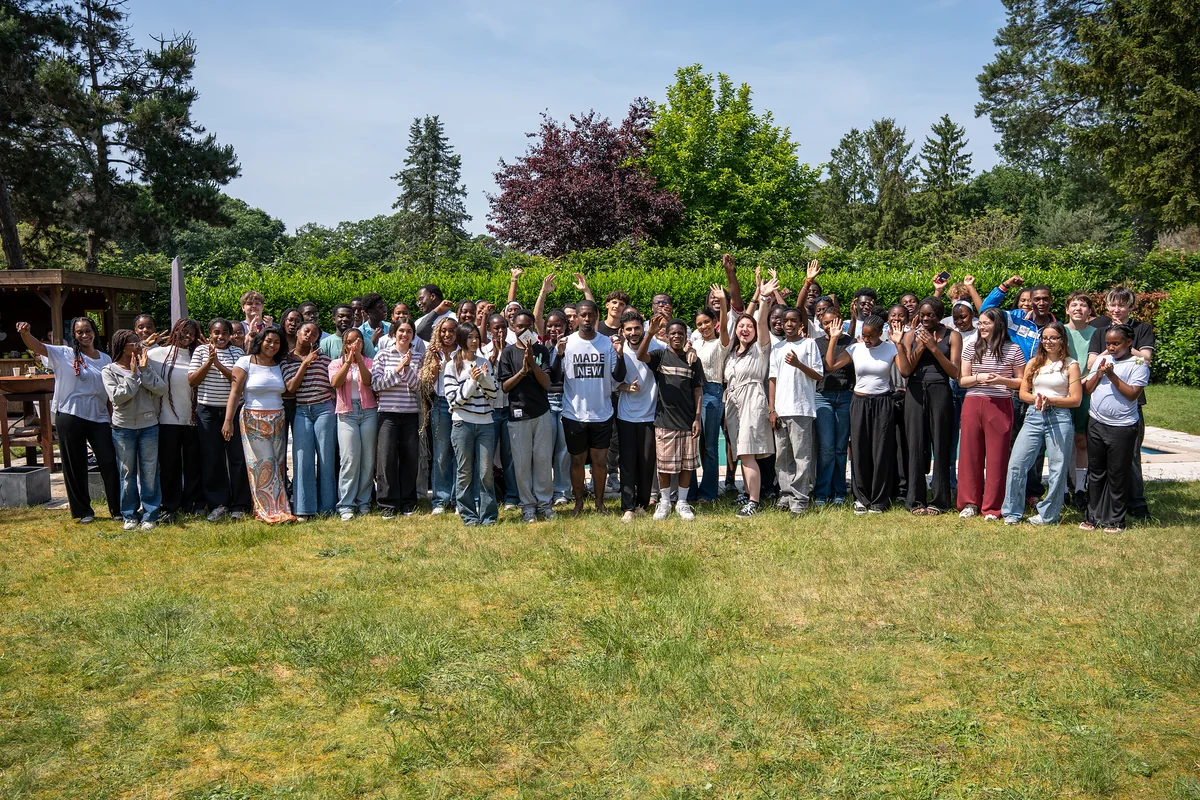
Near the end of the film, a voice from Ghana speaks to Belgium directly. “If you want to save Belgium’s young people,” he says, “I can tell you your government must step in.”3 VRT broadcast, 44:12
The voice belongs to Lawrence Odonkor. As Chapter I showed, he is the former bishop convicted in Madagascar of taking the church’s property, who has lost two appeals. VRT gave him one of its closing lines.
The Belgian government has in fact spoken. On October 22nd, the day after the broadcast, the Minister of Justice, Annelies Verlinden, gave a written reaction. Freedom of religion and freedom of association, she said, are part of the foundations of a democracy under the rule of law. “That freedom is not up for discussion” (Die vrijheid staat niet ter discussie). She did not say that any case, file or investigation about Go Church exists.
As of October 24th, none has been announced. No public prosecutor in Antwerp, Ghent, Leuven or Mechelen has announced an investigation. No court has ruled. Belgium’s official information centre on harmful sects, which can give advice but cannot punish anyone, has given no opinion on the church. What has happened is administrative: halls withdrawn and bookings cancelled, in the days after a television programme.
Belgium’s Constitution protects the right to worship freely in public (Article 19). It also says that no one can be forced, in any way, to take part in a religion’s services or ceremonies (Article 20). The members in this chapter take part because they choose to. They said so, on camera, in their own words.
These charges are not new. Christians have faced them from the beginning.
Before a Roman governor, the apostle Paul was accused of being “a pestilent fellow, and a mover of sedition among all the Jews throughout the world, and a ringleader of the sect of the Nazarenes” (Acts 24:5). In plain words: a troublemaker, a rebel, and the leader of a sect. Later, in Rome, the Jewish leaders told Paul what people said about the Christians: “as concerning this sect, we know that every where it is spoken against” (Acts 28:22).
It kept happening. In 1739 the Bishop of Bristol told the preacher John Wesley, who started the Methodist movement, that his claims were “a horrid thing, a very horrid thing”, and that he had no business in that area. Four years later, a mob dragged Wesley through the streets of Walsall. In 1890, Britain’s most famous scientist, Thomas Henry Huxley, wrote to The Times newspaper warning of “organized fanaticism”, of followers “pledged to blind obedience”, and of a leader with “absolute control” of millions in money. He was writing about the Salvation Army. Today the Salvation Army works in Belgium, as the Leger des Heils.
In none of these cases did calling something a “sect” settle anything. The evidence did.
At the stadium in Accra, six days before VRT aired its film, Bishop Dag Heward-Mills spoke near the end of his message about missionaries.
He told the stadium about William Carey, an English missionary who went to India and “never came back to England”. Then he spoke about James McKeown, a Scotsman who arrived in what was then the Gold Coast, now Ghana, in 1937. McKeown founded the Church of Pentecost, a different church from Bishop Dag’s own. “He said he didn’t want to come to Ghana,” Bishop Dag said, “but he decided to come.” He had recently stood at McKeown’s grave. “And today you see the fruits everywhere.”
A man from Scotland once carried the gospel to Ghana. Today a family of churches started by a Ghanaian bishop gathers young people in Antwerp, Ghent, Leuven and Mechelen. And more than twenty of them have just told their country, in their own words, what it did for them.
Now, back to the real work.
A closing note. See For Yourself was made by members and supporters of the church around the world. No one asked us to make it, and no church paid for it. We made it because we believe the whole story should be told.
Jesus told His followers that this would happen. “If the world hate you, ye know that it hated me before it hated you… If they have persecuted me, they will also persecute you” (John 15:18, 20). And: “Blessed are ye, when men shall revile you, and persecute you, and shall say all manner of evil against you falsely, for my sake. Rejoice, and be exceeding glad: for great is your reward in heaven: for so persecuted they the prophets which were before you” (Matthew 5:11-12).
For many Christians, attacks like this don’t weaken their faith. Jesus said they would come. For some of us, they confirm that we’re in the right place.